|
|
|
CAMP - THE BC
SPCA'S "JUNK SCIENCE" EXCUSE FOR KILLING FOR SPACE - BLAME IT ON THE
'BAD" DOGS.
CAMP: Where's the science?
Posted By: Joann Bessler
Date: Monday, 26 May 2003, at 7:07 p.m.
The SPCA's Companion Animal Management Program (CAMP) contains an
assessment process for dogs which is apparently designed to allow
the SPCA maximum latitude in managing its inventory of retail
product.
Three to Five days after a dog arrives in the shelter it is
assessed using the Hetts Tests. The three possible test outcomes
are: not adoptable, or "Red Zone"; questionable, or "Orange Zone";
and adoptable, or "Green Zone". According to the CAMP Procedural
Manual for Phase One, " ... you should always use the test with the
most unacceptable responses; we need the worst-case scenario, not
the best...." (p. 69).
The SPCA needs the most unacceptable responses from dogs not to
move them into the Red Zone: Red Zone dogs are promptly killed.
Clearly the assessment test, which includes asking a stressed dog to
relinquish food, is unlikely to fill kennels with Green Zone dogs.
The SPCA's use of the Hetts Temperament Test seems intended to
maximize Orange Zone dogs; which, not coincidentally, allows each
SPCA branch the maximum latitude to stock their viewing kennels with
the dogs that sell best.
CAMP is being passed off as a science-based procedure. If the
policy is proven science, the SPCA should identify the peer-reviewed
sources of the program. If the BC SPCA is blazing new ground in
developing these procedures, then it is imperative that experimental
data be published. Have adoption rates improved? Are returns down?
What are the kill statistics before and after implementation of
CAMP?
The SPCA is using CAMP to justify shipping dogs from the far
reaches of the province to wherever they're deemed to be more
marketable. The specious claim of "zero tolerance for the euthanasia
of adoptable animals" is tailor-made to appeal to the donating
public. The immediate result of the media-friendly CAMP may be an
increase in profit from animal sales, and an increase in donations
which have been dropping off due to poor marketing. It's difficult
to conclude that the animals are any better off.
Joann Bessler
AAS Research Co-ordinator
-
A letter to Kim Capri from an ex-CAC member of Victoria SPCA
Jo-Anne Chambers -- Wednesday, 28 May 2003, at 1:45 p.m.
What is the science behind the CAMP assessment tool?
Posted By: Joann Bessler
<
Date: Tuesday, 6 May 2003, at 6:38 p.m.
In Response To:
SPCA Volunteers are upset over CAMP *LINK* (Anita Horne)
Given that current BC SPCA policies support open surrender and
allow local branches to enter into pound contracts, killing of dogs
in excess of shelter holding capacity is inevitable. One can imagine
many ways to choose which dogs will be killed, for example: all dogs
over 70 pounds, all black dogs, or all dogs with pointy ears. Most
people, though perhaps not all, would recognize these criteria as
capricious. Decisions must be made though, the killing must go on as
long as an endless stream of new dogs need to be "sheltered".
Because the donating public in BC were becoming increasingly
dissatisfied with the killing choices made, the SPCA instituted a
"Companion Animal Management Program". In a 2 July 2002 press
release, Dr. Jamie Lawson, the Chief Animal Health Officer for the
BC SPCA, is quoted as saying "As a humane organization we want to
use the best tools at our disposal to assess the physical and
emotional well being of animals in our care and make sound decisions
around their welfare. We now have trained certified assessors across
the province using a reliable management system to ensure this
happens." Part of this management program, according to the press
release, is the use of a "uniform, scientific assessment tool".
What is the science behind the assessment process? More
specifically, just what is the assessment process? If it is truly
"science-based" then it should be published in peer-reviewed
journals. If it is something that the SPCA is proud of, then it
should be detailed on their website. Instead, requests for
information about the assessment tool have gone unanswered.
No rational person can doubt that the SPCA, in its current state,
must kill dogs. Because the CAMP assessment tool is shrouded in
mystery, there is suspicion that the "tool" is nothing more than
disingenuous pseudo-science designed to fail normal dogs. The
obvious conclusion is that the BC SPCA would like the maximum
latitude to kill dogs that require behavioral rehabilitation.
Joann Bessler
AAS Research Co-ordinator
-
SPCA Volunteers are upset over CAMP *LINK*
Anita Horne -- Tuesday, 29 April 2003, at 11:15 a.m.
-
BC SPCA CAMP head side-steps answers
Cross-posted from CYA -- Thursday, 1 May 2003, at 8:20 a.m.
-
AAS questions of CAMP leader, Nadine Gourkow *LINK*
AAS -- Saturday, 3 May 2003, at 9:49 a.m.
-
Orange zone dogs are SPCA wiggle room: Is CAMP to enable the twin
SPCA policies that require it to kill so many animals? *LINK*
AAS -- Saturday, 3 May 2003, at 12:18 p.m.
-
A classic example of how CAMP may be being used to dispose of
dogs that need a lot of time and attention *LINK*
AAS -- Saturday, 3 May 2003, at 3:09 p.m.
- What is the science behind the CAMP assessment tool?
Joann Bessler -- Tuesday, 6 May 2003, at 6:38 p.m.
-
Moratorium on CAMP: Please write the President of the BC SPCA
Anita Horne -- Wednesday, 7 May 2003, at 8:45 a.m.
-
Kangaroo court at CAMP?
AAS -- Friday, 9 May 2003, at 7:11 a.m.
-
Re: SPCA Volunteers are upset over CAMP
Dave Shishkoff -- Friday, 9 May 2003, at 5:02 p.m.
-
SPCA Intake/Outtake policies: CAMP by any other name must
exist
Posted By: AAS
Date: Sunday, 11 May 2003, at 10:19 a.m.
In Response To:
CAMP under fire in Victoria *LINK* (AAS)
Many animal lovers in BC are under the misapprehension that the SPCA
had or has a no-kill policy. And some critics of CAMP believe that
CAMP has replaced this policy and that a better CAMP will mean that
the SPCA will not kill so many dogs.
There seems to be little comprehension that it is the two intake
policies, open surrender and pound contracting, that mean that the
SPCA must have an outtake policy that permits it to kill a lot of
animals. CAMP only does what the SPCA has always done - kill the
unsellable - only now, to prevent itself from being savaged in the
media again as it was after it lied by saying that the six nice dogs
that were killed for space at the Vancouver SPCA in January 2002 were
killed for aggression, now it must have "scientific proof" that dogs
are aggressive before it kills them. Unless the SPCA discontinues
those two intake policies (especially open surrender), and because of
the internet watching and reporting (instead of as formerly with only
the gullible media parroting the SPCA's own words), it must have a
water-tight justification for every death (of dogs at any rate; cats
are not as easy to watch and track).
Unless the SPCA can explain where CAMP is going (and it is
stubbornly uncommunicative as it always has been, further proof that
the SPCA is not reformed in any profound way), then it is open to the
charge that the SPCA's animal welfare policy is in a state of chaos,
and bringing in big guns with strings of degrees and published
research instead of divesting itself of the intake policies that
require so much killing, has only made the chaos worse.
UK animal behaviourist Dr Mugford said privately to an attendee at
the recent Vancouver SPCA seminar where he was a speaker, that CAMP
seemed to be all theory without one action item in it (no remedial
programs) and is an academic exercise that has shown no benefit.
Perhaps the SPCA intends CAMP to be a benefit to animals and it
needs to be given more time for the benefits to be apparent. Perhaps
it needs more time to put its promised life-saving remedial programs
in place along with its death-dealing tests. But as far as can be
seen, CAMP appears to be what AAS has been warning it may be from the
day it was hurriedly cobbled together using the unscientific online
Hetts test with the promise that it would be replaced by the
scientifically validated RSPCA test - that it matters not what test
"tool" the SPCA uses if it is the SPCA's intention is to use it to
justify killing because of its intake policies.
What a black, dirty hole the SPCA climbed into with its
decades-long intake policies, but it is not ever going to climb out
using enabling policies like CAMP.
Only if the SPCA internalizes that honesty really is the best
policy; that only good can flow from honesty; that honesty opens wide
the door to limitless possibilities; that honesty is the only way to
disarm its critics; that honesty will remove the allure of the income
from intake/outtake policies, leaving only solutions that are
animal-serving, not SPCA serving, will the SPCA be able to climb out
if its animal-killing hole.
-
CAMP under fire in Victoria *LINK*
AAS -- Friday, 9 May 2003, at 1:47 p.m.
-
ARK II and David Shishkoff *LINK*
AAS -- Friday, 9 May 2003, at 3:26 p.m.
-
Re: CAMP under fire in Victoria
Jo-Anne Chambers -- Friday, 9 May 2003, at 4:04 p.m.
- SPCA Intake/Outtake policies: CAMP by any other name
must exist
AAS -- Sunday, 11 May 2003, at 10:19 a.m.
-
More shelters is not the answer
AAS -- Sunday, 11 May 2003, at 10:45 a.m.
The "miracle" in the Vernon branch was that Finnigan
escaped the CAMP assessors *LINK* *PIC*
Posted By: OKAWF
Date: Sunday, 28 September 2003, at 8:47 p.m.
Craig Daniell, in his maiden speech as Acting CEO for the BC SPCA
states: "we accomplish miracles every single day in our shelters".
All I can ask is, what miracles? Specifically?
Recently Mr. Daniell and I briefly discussed conditions at SPCA
facilities, and he attempted to get me to admit that Vernon branch,
where I live, is a nice branch, certainly one of the better ones. I
said nothing, and when he pressed the issue, I could only answer
"Well...structurally, I guess."
But what I couldn't seem to impress upon him was that a cage is a
cage, and an overcrowded modern facility is just as stressful and
damaging to the animals it warehouses as is a dingy old facility. Dogs
and cats don't care if their cage is shiny stainless steel or rusty
old metal. To them it's a cage. Only humans care about appearances.
I hope that Mr. Daniell and the Board of Directors are not
satisfied with the archaic method of imprisoning rows upon rows of
sentient beings in their facilities. I hope that the BC SPCA Board and
Executive have set their sights upon a more progressive and humane way
of housing animals in their care, on adopting standards that involve
less caging and more interaction.
But these standards are impossible to adopt and implement as long
as the BC SPCA continues to allow unlimited surrender. Unlimited
surrender means it must accept more animals than it can adequately
care for, and unlimited surrender means it must accept potentially
dangerous animals. And as long as this is the case, the SPCA will have
to use cages to keep everything under control. But no miracles happen
in a warehouse full of caged animals.
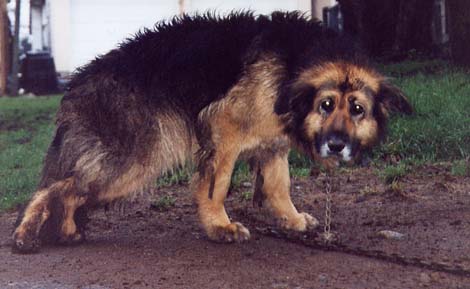
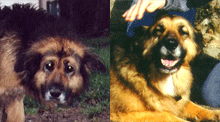
There are two pictures, that whenever I look at hem, illustrate
this argument perfectly.
They are pictures of a dog who spent five days in the Vernon SPCA.
He was fearful to begin with, and only regressed, in his cage, despite
the fact that he had food, water, shelter, toys, and a nice big
blanket. His cage was as cozy and hospitable as any SPCA could make
it, yet it was still a cage, and undersocialized to begin with, he
grew worse, and withdrew further into fear behind the bars.
He became so fearful and withdrawn that a caring staff member
adopted him out to me a day early, as the CAMP assessors were coming
up from the Coast the next day, and in this staff member's opinion, as
well as in the opinion of one of the senior staff: "He's a nice dog
with a lot of potential, but he's not going to pass his assessment."
So I brought him home and let him him explore his new home on his
own, let him gain confidence at his own pace, gave him attention when
he sought it, and his space when he needed it. I asked nothing of him,
as he was not ready. The nice SPCA staff person who let me save him
from the CAMP assessors told me that all he needed was a little
obedience training. Well, after a year of simple confidence building
through allowing him to just be a dog and have fun, now he is ready
for obedience training. He was in no state to handle obedience
training when he came out of the SPCA. He was afraid of floors,
doorways, stairs, men, noises, vehicles, his own shadow. An obedience
class would have been disastrous. A heartfelt, but naive suggestion on
the part of this staff person.
Which reminds me that along with less cages, the SPCA needs to hire
more staff who understand animal behaviour before "miracles" will
happen at all, let alone every day in the branches.
The picture below is of Finnigan after four days in the Vernon
SPCA. The only miracle is that an SPCA staff person cared enough to
sneak him out to me before the CAMP assessors arrived.
Jennifer Dickson
Vernon BC
Read previous posts on this subject: BC SPCA boasts of "miracles in
the branches"
http://www.animaladvocates.com/cgi-bin/newsroom.pl/read/2909
Photos of Finnigan
-
-
Finnigan "after" being rescued by Jen Dickson *NM* *LINK* *PIC*
CAMP should be euthanized
Posted By: AAS
Date: Monday, 14 July 2003, at 7:21 a.m.
Crossposted from CYA:
http://www.b2g3.com/boards/board.cgi?action=read&id=1058141790&user=CYABC
CAMP should be euthanized!
Posted on 7/13/2003 at 05:16:30 PM by mike
I recently reviewed a copy of the CAMP manual. My comments on it,
which are based on my 20 years volunteer experience of dealing with
dogs in a shelter situation, are:
C.A.M.P. Comments (Dogs)
There are a number of fundamental flaws that make the whole process
unacceptable:
It is a process to generate excuses for putting dogs to sleep. It
takes no account of the individuality of dogs and the many reasons
that they are in the shelter in the first place. In fact it is
stated in the Manual that “Orange zone animals that cannot be
adopted by average pet guardians must be euthanized to enable equal
access to resources for all adoptable animals.”
The testing by people unknown to the dogs is nonsense. To get a
true picture of the dog it is far better to have the dog under
standard stable conditions and when the dog has had time to adjust
to being in the shelter. The people who are best able to know how
the animal will react in the “real’ world are those who relate with
it on a day-to-day basis.
It is based on pseudo-science. There is no such thing as a
“science” of anthrozoology - science of human - animal
relationships. The field of study appears to more descriptive and
statistical rather than scientific.
Only one half of the package is given consideration. I.e. the dog
only, nothing about the guardian. The result is that only those dogs
that will be perfect with the “average” guardian will get past the
screening.
The assessment test is biased. The test deliberately works hard
to get the worst case result. If the dog is not perfect then it is
probably sentenced to euthanasia.
The R. Ledger paper, which I presume is a key basis for the
assessment program has a number of questionable statements which
include: pet guardians are said to act as consumers; it states that
“assessing a dog is about taking the guesswork out of predicting if
the dog is a good companion” while at the same time saying that the
“temperament can change if the dog is taught new things“; it states
that dogs, even abused dogs have a choice, and implies that no
special consideration should be given for such cases; it says that
there should be no re-testing since the most unacceptable response
is the one that is wanted; the fact that a dog may be in distress by
actually being in the shelter is not relevant.
I hope that the “new” Board of Directors gives the whole CAMP
process a re-look and throws it out, lock stock and barrel, together
with the authors who dreamt up the whole sorry thing. It is one of
the worst programs that has been put in place for the animals, and
has been a complete negative for the credibility of the BC SPCA.
Sock it to them, Mike!
Jean Martin -- Monday, 14 July 2003, at 7:25 a.m.
Who authorised CAMP?
Jean Martin -- Friday, 18 July 2003, at 3:07 p.m.
Re: Who authorised CAMP?
Jo-Anne Chambers -- Friday, 18 July 2003, at 4:11 p.m.
I want to say how horrified I am at the direction the
BC SPCA is going with CAMP *LINK*
Posted By: Vicki
McDonald, President, Creston PAWS Society
Date: Thursday, 22 May 2003, at 9:50 a.m.
I am president of the Creston Pet Adoption and Welfare Society,
the group that rescued the 56+ mixed breed dogs chained to trees at
Topaz Creek last July.
I want to say how horrified I am at the direction the BC SPCA is
going with their CAMP and other policies regarding the assessment
and treatment of so many of the animals that have been seized
lately.
We hear on a regular basis about one puppy mill seizure after
another because of Craig Daniell's hard work and commitment. I
wonder if he can really feel satisfied about what he has done to
date when he looks at the fate of the animals he is supposed to be
rescuing? I know I would begin to wonder what the point of all that
work is if the animals he safes are just prolonging their misery and
delaying their inevitable execution!
From personal experience, being the primary rescuer, foster mom,
resocializer and rehabilitator of the Topaz dogs, I can attest to
the fact that methods such as those in the SPCA's CAMP are
unreasonable, unrealistic and absolutely ridiculous. NONE of the
Topaz dogs would be able to pass those tests. The 50 plus proud,
wonderful families that have taken a Topaz dog into their homes and
hearts and send me regular testaments of what a little time, love,
care and training can do are living proof that what the SPCA is
doing is WRONG!!!
The SPCA seems to be nothing more than a bulk disposal service,
bent on ridding the province on all but a few "perfect" pets!
Why doesn't the SPCA realize that the best pets are those that are
given the proper environment of a safe, loving home, regardless of
their background. The sterile, unfeeling, prison-like environment of
the SPCA shelters are an impossible place for a pet to display its
true character. Imagine what would happen if a 2 year old child were
to be placed in such an environment. What kind of social behaviour
would that child develop?
Our rescue of the Topaz dogs last summer, dogs that were
completely unsocialized, underfed, chained, wounded and abused, is
proof of the fact that MOST dogs are rehabilitatable, given the
chance. WE did it, without temperament testing, without
professionals, WITHOUT AN ANIMAL SHELTER!!! And last week, three of
those dogs (ones that are still needing homes, but in the meantime
are being fostered, loved, and obedience trained at my home) that
would surely have been euthanized almost immediately by the SPCA and
their CAMP test, calmly and happily marched down main street in our
local Victoria Day parade, led by local children!
As far as I can see, the SPCA is going backward into a policy of
coldness, brutality, and needless slaughter rather than one of care,
compassion and rehabilitation. It makes me wonder if the ones making
the decisions have their own, or even like animals at all!
When volunteers of the BC SPCA are quitting in such numbers,
don't they get the message?? If the SPCA were doing it "right" there
would be no need for all of us private rescues! It is time they
faced the fact that they have made some drastic mistakes, and time
they STOPPED!!! Get out of the "science" and "business" of animal
"control" and get into the wonderful rewards of animal Welfare and
Rehabilitation!
Vicki McDonald, President
Creston PAWS
Read how Creston PAWS rescued and rehomed many abused and neglected
large-breed dogs at:
http://www.animaladvocates.com/beaverdell-topaz.htm
Background posts on CAMP and the Killings at the Kamloops SPCA
CAMP: Official policy or just a draft?
Posted By: AAS
Date: Friday, 25 July 2003, at 7:37 a.m.
Both the President and the acting CEO of the BC SPCA have said that
the SPCA's dog assessment test, CAMP, is only a draft. This is not
true as CAMP was adopted as policy by the BC SPCA Board of Directors
on May 10, 2002, but it does make it sound as though the much-hated
and very questionable program was never official.
AAS member, Joann Bessler, has made these observations:
The research protocol may change during the course of the research.
Specifically, the "CAMP Procedural Manual for Phase One" states that
one of the Phase 4 goals is to "evaluate and refine CAMP practices"
(p.4). Are we already in Phase 4?
The same manual also directs that animals are only to be
transferred if, among other criteria, "they have been classified as
green zone (adoptable) animals" (p. 41).
So, CAMP Phase 1 instructs that orange zone animals are not to be
transferred, but the manual also states that the protocols will be
changed in the future.
There are two problems with evaluating the effectiveness of CAMP:
1) We don't know what the protocols or the outcomes are.
Because of SPCA secrecy, we don't know which sections of the Phase 1
CAMP Procedural Manual have been superseded. CAMP's mission, "... to
improve the welfare of companion animals in shelters and the
community...." is laudable, the SPCA should be trumpeting CAMP from
the mountaintops if they're proud of it.
The SPCA has not, as far as I know, ever published statistics on
outcomes. We can not objectively measure improvement without data; we
must know intake, adoption, and kill figures.
2) CAMP policy has not been uniformly applied.
Even for researchers with access to all of the current CAMP protocols
and intake vs outcome statistics, it has become clear that procedures
have fluctuated from shelter to shelter at the whim of local staff. It
would be extremely difficult for any defensible conclusion to be drawn
from such a flawed case study.
Joann Bessler,
MSc
-
CAMP Colors Are For Killing! *LINK*
Gail Moerkerken -- Saturday, 26 July 2003, at 1:17 p.m.
-
Re: CAMP Colors Are For Killing!
Jo-Anne Chambers -- Monday, 28 July 2003, at 9:17 a.m.
A letter from
BS SPCA Regional Manager Bob Busch - a reason that we can still not
trust the SPCA
Posted By: AAS
Date: Saturday, 24 May 2003, at 7:18 a.m.
A letter from BS SPCA Regional Manager Bob Busch - a reason that
we can still not trust the SPCA
Mr Busch wrote this letter in response to the outrage at the
killing by the Kamloops SPCA of a cocker spaniel and a poodle which
had been surrendered from a puppy mill to the Kamloops SPCA. They
were killed in spite of many offers from volunteers to foster them,
and in spite of the pleas of Lynda Miller of Kamloops to be allowed
to adopt one of them. They were killed because this is what the SPCA
has always done - killed in preference to using any outside offers
of help. Read how the Kelowna SPCA using CAMP killed many dogs
seized from a roadside breeder, in spite of many offers from
volunteers who were allowed to come to love the dogs over many
months and walk with them. CAMP/Kelowna SPCA said they were
aggressive. Look at their pictures and read volunteer's testimonies
and judge for yourself.
http://www.animaladvocates.com/beaverdell-topaz.htm
Not only did Kelowna volunteers beg for the lives of the
Beaverdell dogs, but the Alaskan Malamute Help League's offer to
foster and rehabilitate was ignored too.
The cocker and the poodle "sheltered" by the Kamloops SPCA were
killed using CAMP, the BC SPCA's new tool to prevent critics from
accusing it of killing arbitrarily at the whim of any member of
staff who happens to feel like it. CAMP, in its current form, with
tests to determine temperament but without any remediation program,
is a weapon against dogs and a shield for the SPCA and a devise to
keep the SPCA in the pet disposal business.
Please write your concerns about Mr Busch's letter and the use of
CAMP to euthanize dogs at the Kamloops SPCA to Thompson Region BC
SPCA director Pat Cutler at
pcutler@cariboo.bc.ca and to the Kim Capri, Chief Operating
Officer of the BC SPCA at
kcapri@spca.bc.ca and to the President of the BC SPCA, Rick
Sargent at roxiegirl@shaw.ca
and to Craig Daniell, BC SPCA CEO and Manager of Cruelty
Investigations at
cdaniell@spca.bc.ca.
Link to more posts on the Kamloops killings and the letter from
Lynda Miller of Kamloops that started it all:
http://www.animaladvocates.com/cgi-bin/admin_config.pl/read/2509
Link to more posts on the BC SPCA's killer CAMP
http://www.animaladvocates.com/cgi-bin/admin_config.pl/read/2414
This is Mr Busch's letter to selected critics of the killings. Mr
Busch did not send his letter to Lynda Miller who is the witness to
what was done, nor to AAS...
This letter is written to all those who have communicated
dissatisfaction with the euthanasias last week of two dogs at the BC
SPCA Kamloops shelter. Although I personally was not aware of the
situation until yesterday, I have reviewed the case with the Branch
Manager and support her decision.
The two dogs in question were unsocialized and extremely fearful
of humans. Although a month was spent attempting to rehabilitate the
dogs, they did not improve and it was deemed inhumane to let them
live in constant fear of humans. That reluctant decision was made by
two qualified assessors and a Companion Animal Management Program
trainer, who were unanimous in their decision.
Although the BC SPCA supports the use of qualified and
appropriate foster homes and rescue groups, it was decided that the
nature of these dogs' behaviour would not have been improved in a
foster/rescue situation.
Allegations that the dogs were euthanized due to barking are
totally false, as is the statement that one remaining dog was slated
for euthanasia on May 20th.
We appreciate the concern shown by all those who have
communicated with us and hope that you, in turn, will appreciate
that the BC SPCA is forced to make very difficult animal welfare
decisions on a daily basis. Our CAMP assessment tool is a method of
assisting that decision-making process through evaluating an
animal's emotional/behavioral state. The tool is not perfect, but
does allow us some objectivity in deciding an animal's future. If
you disagree with the tool, that is your right, but please ask
yourself if it is acceptable to allow an animal to live a life of
fear and suffering. Quality of life vs quantity of life: that is the
moral/ethical dilemma with which we were faced and we acted, as
always, in the best interests of the animals concerned.
Our thanks for your strong support of animal welfare. The animals
of this province are fortunate to have so many voices acting on
their behalf.
Robert Busch
BCSPCA Regional Manager, Interior
email: bbusch@spca.bc.ca
Read the posts in this thread to see why we think Mr Busch's
letter is not "accurate".
-
-
Background on the Kamloops CAMP killing
AAS -- Saturday, 24 May 2003, at 7:49 a.m.
-
Here are the "facts". Lynda Miller's response to Busch's
inaccurate letter
AAS -- Sunday, 25 May 2003, at 7:01 a.m.
-
Okanagan Animal Welfare Foundation is also being ignored by the
SPCA
AAS -- Sunday, 25 May 2003, at 7:06 a.m.
Who should kill society's unwanted dogs?
Posted By: AAS
Date: Thursday, 26 September 2002, at 9:37 a.m.
AAS has rehabilitated dogs that would not have scored well on any
of the CAMP test's steps. But it has taken up to three years - in
home settings - to rehabilitate them. There are only a very few
dedicated individuals who are willing or have the right personality
to do this. How can any organization afford to do this on the scale
the SPCA's policies of pound contracting and open surrender
necessitates? The failure is not in the CAMP tests, but in SPCA
policy that results in jammed facilities.
And here we get to the heart of the matter. Should the SPCA be
society's dog-disposer?
If yes, then should the SPCA be doing it on such a large scale
that there will need to be a lot of killing and employees who see
killing as a reasonable solution? Some percentage of dogs in SPCAs
will fail these tests and the greater the number of dogs taken into
the SPCA the greater the number that will fail and will have to be
killed.
AAS argued from the beginning that it is corrupting to be in the
dog-disposal business and we proved that indeed the SPCA was
corrupted. As currently constituted (pound contracts and an open
surrender policy), the SPCA has a high volume of dogs to dispose of.
Because of the exposure on television of the Vancouver SPCA's
killing of six nice dogs for space, in February of this year, which
the SPCA tried to justify on the grounds that the dogs were
aggressive, the SPCA has had to put a system into place that
justifies to the public and to the media all future killings - so
that this kind of negative publicity, which results in an immediate
loss of donations, will never happen again. Hence "science based"
temperament testing protocols that legitimise the "aggressive"
label, headed by Nadine Gourkow, a "scientist" with university
degrees to legitimise the process.
From information we have received, we don't believe Gourkow
understands dogs (she is a cat specialist and only recently became
the owner of a dog - one nice dog). But a person who understands
dogs is not what the SPCA needed, in fact a person with many years
experience in dog rehabilitation was just what the SPCA did not
want. That person would be able to see how a dog could be
rehabilitated if only it were given enough time, or enough money
were spent on it, things the SPCA does not have. It does not have
enough time or money because the business of disposing of society's
dogs creates a volume of dogs too great to give dogs the individual
help that would save them. Even if the BC SPCA stopped paying it's
executive staff such high salaries, stopped paying for trips to
England and retreats to Harrison Hot Springs, stopped expanding its
head office staff from ten to over thirty, it still would not have
enough money to give true "shelter" to all the dogs it has
contracted to dispose of.
The SPCA needed a person who is familiar with scientific jargon
who would appease the media and keep it from ever again exposing the
SPCA the way it did in February. The SPCA needed a "team player"
loyal to the bosses. A person with years of real, hands-on
experience in dog rehabilitation may have balked at the underlying
hypocrisy of the temperament testing, seeing that it is a "tool",
not to save dog's lives, but to save the SPCA from the loss of
donations that public exposure of killing causes.
From what we have been told the temperament tests are being used
in some instances to get rid of dogs that are merely "difficult to
sell". This is no different than what the SPCA has always done,
except it used to do it without fear of exposure or censure. Now it
is done from the safety of "scientific protocols". And from what we
have been told, the orders to kill dogs are being given by novices
with only a few days training.
Nadine Gourkow said in an interview on CBC radio, September 19th,
that "science has taught new things about animal behaviour". This is
media-friendly, junk- science babble. It could only teach something
new to someone who knew nothing.
AAS read the first temperament testing protocol, the one the SPCA
hurriedly put into place in March in a frantic attempt to counter
the deadly publicity of the six dogs-killing in February. This
method was not "scientifically validated" but it had to do until
Gourkow could receive accreditation from the RSPCA in England for
its testing system.
AAS thought then that the SPCA putting in place a system to
justify killing could only mean that the SPCA intends to go on
disposing of the majority of unwanted dogs in BC for some time.
The dog-disposal business is corrupting - if it is done by anyone
who is also in the animal welfare business. The line between the
two, animal welfare and animal disposal, must be blurred for
donations from animal-lovers to keep coming in. Dog-disposal done by
pounds is nasty, brutish, and cruel, but it is also open and
straightforward. Pounds kill because there are more dogs than homes,
more product than purchasers. So do SPCA pounds, but the SPCA has
deliberately hidden this to protect its donation income. Only by
refusing to do this, under any guise, including the guise of
science, will the SPCA be in a position to educate the public as to
why so many dogs are disposed of. But it can't possibly risk doing
that while claiming to be saving animals (animal welfare) and also
doing animal-disposing (animal control contracts). And it appears
from the use of the "justification tool" that the SPCA intends to go
on being society's primary dog-disposer.
Who should be killing society's unwanted dogs?
We think it should be municipal pounds so that it can be open and
acknowledged and the public can be told honestly that the killing is
caused by overbreeding, desocializing by isolation (yard/guard
dogs), and abandonment, and that these causes need to be legislated.
Only if the public knows the truth will the shame of all the killing
be addressed.
But what is happening is that some municipal pounds have got on
the "no-kill" bandwagon so that in some municipalities both the
pound and the SPCA are trying to find ways to justify the
dog-killing that uncontrolled breeding, desocializing, and
abandonment makes inevitable.
We know that some SPCA branches are doing a much better job of
disposing of dogs than others, but those branches are not legally
obligated by a pound contract to become crowded with unsellable
dogs. Crowded SPCAs must kill, or sell to anyone with the money,
regardless of how unsuitable the purchaser is, with no regard to the
animal's future.
The important point is this... that only municipal pounds have a
legal obligation to dispose of dogs - the SPCA has no obligation to
do it.
But in the 1950's the SPCA chose to get into the dog-disposal
business. The SPCA claims to have done this because it would treat
dogs better than municipal pounds did, but AAS showed conclusively
that the SPCA's treatment of dogs, and its methods to kill them, was
cruel and inhumane too, for the same reason that municipal pounds
were cruel - money... the bottom line. It is cheap to kill dogs and
expensive to save them.
Again - the question that needs to be answered first is not how
and for what reason we should kill unwanted dogs, but who should
kill them.
AAS believes that it should not be the BC SPCA that kills
society's unwanted dogs. Rather we believe the SPCA should be three
things: the enforcer of humane standards of dog-disposal by
municipal pounds; the crusaders for laws to prevent the causes of so
many dogs having to be disposed of; and the indefatigable educator
of our society's expectations of animal welfare. But perhaps there
just isn't enough money in that.
-
CAMP Test Should Be Scrapped
Anita Horne -- Thursday, 26 September 2002, at 4:40 p.m.
-
Re: CAMP Test Should Be Scrapped
Jean -- Thursday, 26 September 2002, at 7:30 p.m.
-
Re: CAMP Test Should Be Scrapped
AAS -- Thursday, 26 September 2002, at 8:00 p.m.
-
It's the Same Thing...only Different!
Anita Horne -- Thursday, 26 September 2002, at 10:50 p.m.
-
Re: CAMP Test Should Be Scrapped
Angus -- Friday, 27 September 2002, at 4:08 p.m.
-
Re: CAMP Test Should Be Scrapped
Joanne -- Friday, 27 September 2002, at 9:00 p.m.
-
Re: CAMP Test Should Be Scrapped
Joanne -- Saturday, 28 September 2002, at 6:46 p.m.
-
SPCA DOG BEHAVIOUR EVALUATION TEST
AAS -- Friday, 27 September 2002, at 11:07 a.m.
-
How is this test scored?
Joanne -- Friday, 27 September 2002, at 11:21 a.m.
-
It's not about the test it's about the intent
Pat Webber -- Friday, 27 September 2002, at 7:36 p.m.
-
RSPCA validation, SPCA intention?
AAS -- Sunday, 29 September 2002, at 8:27 a.m.
-
Re: SPCA DOG BEHAVIOUR EVALUATION TEST
Emma -- Friday, 27 September 2002, at 9:06 p.m.
-
The test is just going to freak the dog out
Crystal -- Saturday, 28 September 2002, at 8:40 a.m.
|
|